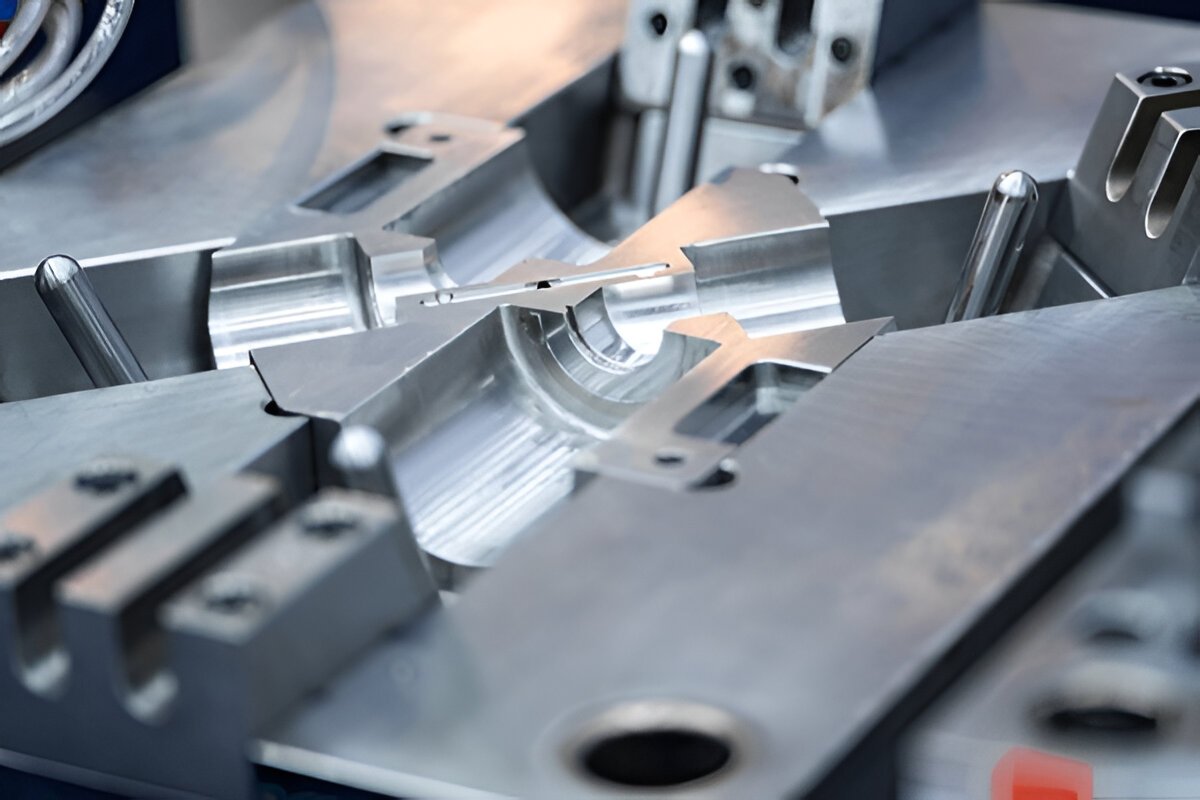
The construction of a die casting mold is a precision discipline that integrates mechanical design, metallurgy, thermal management, and machining technologies. Every design decision directly affects mold lifespan, dimensional stability of the casting, and process repeatability. The key technical steps are analyzed below with a practical approach oriented toward the workshop and the technical department.
- Definition of Geometry and Functional Breakdown
Construction begins with dividing the mold into functional subassemblies, each with specific requirements:
Mold base (fixed and moving halves)
Cavity and core inserts
Side slides and movable blocks
Ejection, cooling, gating, and venting systems
The choice between integral or inserted components is crucial:
Inserted components: allow targeted maintenance and localized replacement.
Monoblock inserts: ensure greater rigidity but increase cost and repair time.
The parting line (closing plane) must be designed to minimize flash formation, ensure stable closure under load, and reduce post-casting finishing operations.
- Material Selection
Steel selection is one of the most critical factors. Materials must be chosen according to the alloy to be cast, the expected thermal cycle, and the required service life.
Steels 1.2343 / 1.2344 (H11 / H13): standard for cavity inserts; offer an excellent balance between thermal resistance, toughness, and machinability.
Steel 1.2367: suitable for areas subject to high thermo-mechanical stress.
Quenched and tempered steels: used for mold bases and structural plates.
Evaluation parameters: resistance to thermal fatigue (heat checking), thermal conductivity, response to surface treatments, and dimensional stability after heat treatment.
- Machining Allowances and Tolerances
During construction, it is essential to properly plan cumulative dimensional shrinkage and distortions caused by heat treatment.
Typical machining allowance for cavities: +0.3 / +0.5 mm.
Finishing: final grinding operations must only be carried out after heat treatment.
Fits: for slides and guides, H7–H8 tolerances are recommended, with calibrated clearances to compensate for thermal expansion.
Important note: excessively tight tolerances often cause seizure during hot operation.
- Gating and Venting System
Gating channels must ensure geometric continuity and progressive cross-sections without sharp edges.
Machining: CNC cycles with dedicated tooling are recommended to avoid micro-steps.
Polishing: must be functional (oriented according to flow direction), not purely aesthetic.
Vents: essential for quality. Typical depth 0.02–0.05 mm (depending on the alloy), with progressively increasing width toward the outside to facilitate gas evacuation.
- Thermal Regulation (Cooling)
Cooling is the most complex aspect to implement. An incorrectly drilled hole is often irreversible.
Geometry: maintain a uniform distance from the cavity surface and avoid “dead zones.”
Advanced solutions: use of conformal cooling channels or inserts made of high-conductivity alloys (e.g., copper-beryllium) in thermally critical areas.
- Ejection System
It must ensure uniform force distribution to prevent bending or breakage of the casting.
Components: hardened and ground ejector pins, polished and treated guides.
Functional clearance: the clearance between pin and bore must account for operating temperature; a perfect fit when cold may result in sticking when hot.
- Assembly and Final Checks
Assembly represents the final functional verification. Essential checks include:
Flatness of closing surfaces (inspection with Prussian blue).
Smooth movement of slides and mechanical components (dry run tests).
3D dimensional inspection of cavities compared to the mathematical model.
The quality of a die casting mold does not depend on a single decision, but on the technical coherence of all construction phases. Proper materials, functional tolerances, well-designed cooling, and precise assembly are what distinguish a “working” mold from an industrial, stable, and long-lasting one.
Send us a quote request
SEND
EDR FITTINGS SRL
Via Paleocapa, 75/77/83R
16135 GENOVA
CERTIFICATION


SOCIAL

